
Getting Started with MultiNEAs
This notebook demonstrates how to load and use the MultiNEAs package for studying Near-Earth Asteroid dynamics and populations.
Installation
If you’re running this in Google Colab or need to install the package, uncomment and run the following cell:
[1]:
try:
    from google.colab import drive
    %pip install -U multineas
except ImportError:
    print("Not running in Colab, skipping installation")

# Uncomment to install from GitHub (development version)
# !pip install git+https://github.com/seap-udea/MultiNEAs.git
Not running in Colab, skipping installation
Load the Package
Import the MultiNEAs package:
[2]:
import multineas as mn
import numpy as np
import matplotlib.pyplot as plt

# For Google Colab users
%matplotlib inline
Verify Installation
Check that the package loaded correctly:
[3]:
# Display package version and information
print(f"MultiNEAs package loaded successfully!")
print(f"Package location: {mn.__file__}")
print(f"\nAvailable modules:")
print([item for item in dir(mn) if not item.startswith('_')])
MultiNEAs package loaded successfully!
Package location: /Users/jzuluaga/dev/MultiNEAs/src/multineas/__init__.py

Available modules:
['AUTHOR', 'EMAIL', 'MultiNEAsBase', 'VERSION']
Basic Usage Example
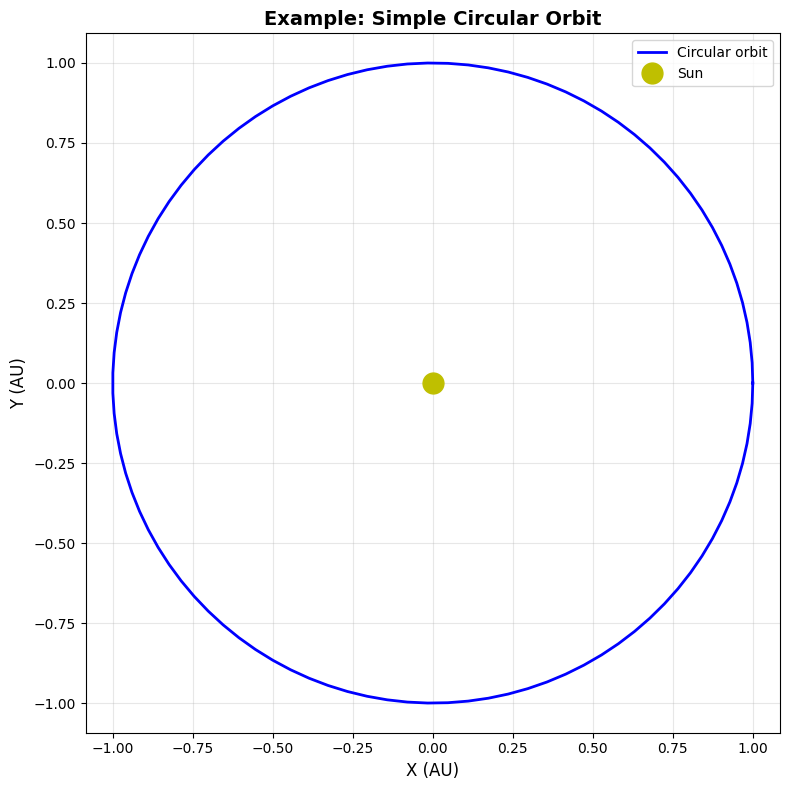
Here’s a simple example to demonstrate the package functionality:
[4]:
# Example: Create a simple plot
# This is a placeholder - replace with actual MultiNEAs functionality

# Sample data for demonstration
angles = np.linspace(0, 2*np.pi, 100)
x = np.cos(angles)
y = np.sin(angles)

plt.figure(figsize=(8, 8))
plt.plot(x, y, 'b-', linewidth=2, label='Circular orbit')
plt.plot(0, 0, 'yo', markersize=15, label='Sun')
plt.xlabel('X (AU)', fontsize=12)
plt.ylabel('Y (AU)', fontsize=12)
plt.title('Example: Simple Circular Orbit', fontsize=14, fontweight='bold')
plt.grid(True, alpha=0.3)
plt.axis('equal')
plt.legend()
plt.tight_layout()
plt.show()
Next Steps
Now that you have successfully loaded the MultiNEAs package, you can:
Explore the available modules and functions
Work with orbital dynamics calculations
Analyze NEA populations
Create visualizations of asteroid data
For more information, visit the GitHub repository or check the documentation.
MultiNEAs - Numerical tools for near-earth asteroid dynamics and population
© 2026 Jorge I. Zuluaga and Juanita A. Agudelo